
AI is changing B2B sales.
More than 40% of business leaders have seen measurable productivity gains from implementing AI automation.
The first call, that bedrock of outbound sales, is getting a makeover. And it’s not coming from sales trainers or new methodologies. It’s coming from AI.
And we’re not talking about chatbots with voices or glorified phone trees.
We’re talking about AI that can actually hold a conversation, ask follow-up questions, and decide whether someone’s worth a human rep’s time. These systems can navigate unexpected responses, handle objections with nuance, and even pick up on verbal cues that suggest genuine interest versus polite deflection.
They’re sophisticated enough to know when a prospect says “maybe later” but sounds genuinely curious versus when they’re just trying to end the call.
Some can even adapt their communication style mid-conversation, switching from formal to casual, or adjusting their pace based on how the prospect responds.
Challenges with traditional B2B first-call methods
Let’s be honest about first calls in B2B sales: too often, they fall short of delivering value for either side.
Despite being a foundational step in pipeline generation, it consistently underperforms in both reach and relevance.
From the sales side, the process is often a volume-driven exercise. Most calls go unanswered. Of those that do connect, many end in under a minute. Reps routinely spend time on conversations that were never viable, and that could be due to misaligned roles, poor timing, or targeting the wrong organization altogether.
From the prospect’s perspective, cold outreach often feels misaligned and intrusive. Calls arrive without context, relevance, or personalization. The experience is frequently one of fielding offers for products that don’t address current needs. And these calls often come at times that interrupt, rather than inform.
At the core, it is a resource allocation problem.
Human sales representatives are finite and costly. Each call requires full cognitive and emotional engagement, regardless of whether the recipient is a qualified decision-maker or a misrouted contact.
This forces organizations into a trade-off: either limit outbound volume, which reduces potential reach, or scale aggressively and accept a decline in call quality and conversion.
Neither approach is sustainable.
Therefore, companies are rethinking how the first call is made. Instead of relying solely on human reps, many are turning to AI voice agents.
Traditional call challenges | What AI voice calls solve |
Low response rate | AI executes persistent, multi-timezone, and off-hours outreach, improving connect rates. |
Poor timing of outreach | AI optimizes call timing using behavioral data and can instantly retry missed connections. |
Misalignment with prospect needs | AI qualifies based on role, industry, pain points, and timing before human involvement. |
Lack of personalization | AI adapts tone, language, and questions dynamically based on conversation cues. |
High rep burnout and inefficiency | AI handles repetitive top-of-funnel calls, freeing reps to focus on complex, high-value deals. |
Inconsistent qualification and messaging | AI applies standardized logic across every conversation, ensuring message consistency. |
Missed data capture and CRM hygiene issues | AI logs all conversations, flags objections, and auto-updates CRM with structured insights. |
What are AI voice agents?
An AI voice agent is an autonomous software system capable of conducting spoken conversations with human users in real-time. It listens, interprets, responds, and adapts, often within milliseconds, simulating the dynamics of a human-to-human call.
These agents are designed to recognize speech, and comprehend context, intent, sentiment, and conversational flow.
In simple words, an AI voice agent is basically software that can talk on the phone like a person. The AI can make outbound calls to prospects, take inbound calls, or handle specific parts of a sales conversation before passing things off to a human.
What is the tech behind AI voice agents?
AI voice agents are not monolithic systems. They are a coordinated stack of real-time processing tools working in unison. At a high level, four core components make the system work:
- Automatic Speech Recognition (ASR): This converts spoken language into text. The quality of transcription depends on contextual understanding, speaker accents, audio clarity, and the sophistication of the model.
Older systems relied on generic speech models; newer ones are trained on domain-specific vocabulary (think: SaaS acronyms, industry lingo, or even regional pronunciation).
- Natural Language Understanding (NLU): Once transcribed, the AI interprets the meaning. This involves not just understanding the literal words but also parsing intent, sentiment, and uncertainty.
A phrase like “I’m not sure right now” could signal indecision or polite disinterest. So, the AI must infer the difference through tone, historical patterns, and context.
- Decision-making engine: Here, the system determines how to respond. This isn’t a rigid decision tree.
Advanced agents use probabilistic models, reinforcement learning, and dialogue policy optimization to decide the next move, which include asking a clarifying question, introducing a new topic, or politely ending the call.
- Text-to-Speech (TTS): The response is rendered into speech. High-performing agents use neural TTS models capable of dynamic intonation, emphasis, and emotional variance.
These systems can pause appropriately, speed up or slow down based on the prospect’s speaking style, and even inject hesitations or interruptions to mimic human conversation flow.
Real-time conversation at scale demands exceptionally low latency. Each component, from speech recognition to response generation, must operate within milliseconds. Recent advances in cloud-native architecture and GPU-accelerated processing have made this level of orchestration not only possible, but dependable in production environments.
How AI voice agents improve sales operations
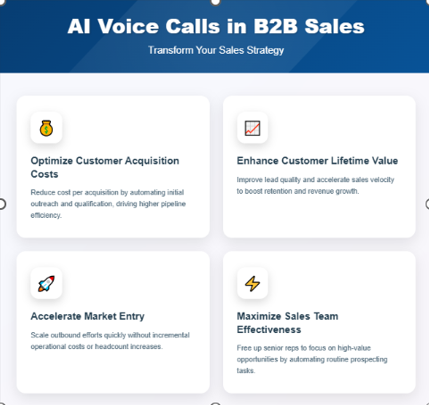
AI voice agents are making sales teams more efficient by handling the front line of outbound engagement. Their strength lies in their ability to perform repetitive, high-volume tasks with consistency, accuracy, and speed, enabling human reps to focus on higher-value work.
Here’s what they enable in practical terms:
- First-call consistency
Every call follows the same logic. The AI asks the right questions, captures the same data points, and follows the same qualification criteria regardless of when or how often it’s deployed. There’s no risk of skipping steps or going off-script. This gives teams consistency across thousands of conversations. - Faster lead filtering
AI voice agents can usually determine within the first 30 to 60 seconds whether a lead is worth passing on. They listen for key signals, such as timing, role fit, interest level, and make quick decisions based on that. That means fewer hours wasted on leads that were never going to convert in the first place. - Improved data fidelity
Calls are logged automatically. The AI records not just that a call happened, but what was said, what objections came up, and what the next step should be. All of that gets written to the CRM without requiring a rep to type up notes. The result is more complete and more reliable data for everyone, whether that’s sales managers, marketing ops, or revenue teams. - Higher response coverage
These systems can call across time zones, retry missed connections, and follow up at off-hours, all without adding to a team’s workload. They also handle concurrent conversations, so you’re not bottlenecked by how many reps you have on the floor that day. - Better connection through language flexibility
AI voice agents can operate in multiple languages, and in some cases, switch languages mid-call when needed. This matters for teams working across regions or selling into multilingual markets. It reduces friction in the conversation and builds early trust across local and global markets. - Real-time adaptability
Unlike traditional scripted calls, AI voice agents adjust as the conversation develops. If someone seems interested, the agent keeps going by asking deeper questions or offering to schedule time with a human rep. If someone clearly isn’t interested, the agent backs off and exits cleanly. That responsiveness makes the interaction feel natural, not forced. - More room for testing and iteration
Because AI voice agents operate at scale, companies can test different versions of call scripts, opening lines, or qualification logic across hundreds of calls. That creates room for structured experimentation. Instead of guessing what works based on a few top performers, teams get real data on what actually moves the conversation forward. - A clearerdistinction of roles
With AI handling the early filtering, human reps can focus on the conversations that require experience, judgment, and context. Reps are not stuck qualifying leads that don’t meet basic criteria. They’re doing the work that actually closes deals, like negotiating, explaining value, navigating objections.
What are the emerging AI voice technologies in 2026?
In 2026, getting the words right isn’t the impressive part anymore. What’s more interesting is what the AI does with the words. Can it identify hesitation? Change its tone when someone sounds annoyed? Learn from hundreds of calls? That’s where the progress is happening.
- Self-learning dialogue models: Some systems now use reinforcement learning from human feedback (RLHF) and continuous fine-tuning based on actual call outcomes. This allows agents to learn from failed calls and optimize over time.
- Emotion and sentiment analysis: These models can detect not just what someone says, but how they say it, including micro-expressions in tone that indicate fatigue, irritation, or curiosity. This helps agents decide whether to escalate, change tone, or disengage.
- Multilingual and code-switching capabilities: Voice agents in global sales environments now switch languages mid-call or recognize when prospects code-switch between dialects. This improves effectiveness in local and global markets.
- Voice cloning and personalized personas: Enterprises are experimenting with AI agents that reflect brand tone or even individual reps’ styles. It is almost identical to cloning your best-performing SDR’s voice patterns, including tone, energy, inflection, and deploying it at scale.
- Real-time human-in-the-loop escalation: When the AI senses it’s approaching the limits of its logic or encounters a complex objection, it flags the conversation for a human handoff. This hybrid model maintains fluidity while minimizing human effort.
These technologies are being deployed by leading SaaS companies, large BPOs, and sales-driven organizations that treat outbound as an optimization problem, not a volume problem.
Overcoming common challenges with AI voice calls
While the benefits of AI voice agents are compelling, many B2B organizations face common concerns when implementing the technology. The key to success lies in anticipating these challenges and addressing them early.
- Prospectdiscomfort with AI
Some prospects may react negatively when they realize they’re speaking with an AI, especially if the handoff feels unnatural. The solution isn’t to hide the fact, but to design interactions that are clear, helpful, and human-like from the first sentence. Framing the AI as an intelligent assistant rather than a replacement builds trust early. - Accuracy inunderstandingcomplex responses
AI voice agents can struggle with ambiguous language, technical jargon, or regional dialects. Modern systems mitigate this by being trained on industry-specific datasets and incorporating feedback loops to continuously improve. Fine-tuning based on real call data is critical. - CRMintegration andworkflow fit
AI that operates in isolation can cause friction with existing sales operations. The real value comes when voice agents are embedded directly into CRM workflows, automatically updating records, tagging leads, and surfacing insights. Choose solutions that offer native or flexible integrations. - Managingescalation andhandoffs
AI must know when to exit gracefully and when to escalate. Poorly timed handoffs frustrate both reps and prospects. High-performing systems use real-time confidence scoring and sentiment analysis to detect edge cases, routing complex conversations to humans without losing context. - Maintainingbrand voice and compliance
Consistency in tone, messaging, and compliance is essential. Modern AI agents can be trained on brand guidelines and conversation frameworks, ensuring every call reflects the company’s voice while adhering to legal and ethical standards. - Internalresistance toadoption
Sales teams may fear AI will replace them or distrust its accuracy. Success requires framing AI as a force multiplier. Involving frontline reps in pilot programs, showing measurable results, and positioning AI as a tool to offload low-value tasks can accelerate buy-in.
Closing the loop
Replacing the first call with AI voice agents is about structural efficiency.
B2B sales relies on initial conversations to qualify, route, and prioritize. When those conversations are inefficient, everything downstream suffers. Reps spend too much time chasing uninterested leads. Managers operate on noisy data. Prospects receive irrelevant outreach.
The result is predictable: low conversion, high churn, and pipeline bloat.
On the other hand, AI voice agents handle volume and shift human effort to where it matters: solving complex problems, building relationships, and closing deals.
In short, AI voice agents don’t just pick up the phone, they make sure it’s worth picking up.