
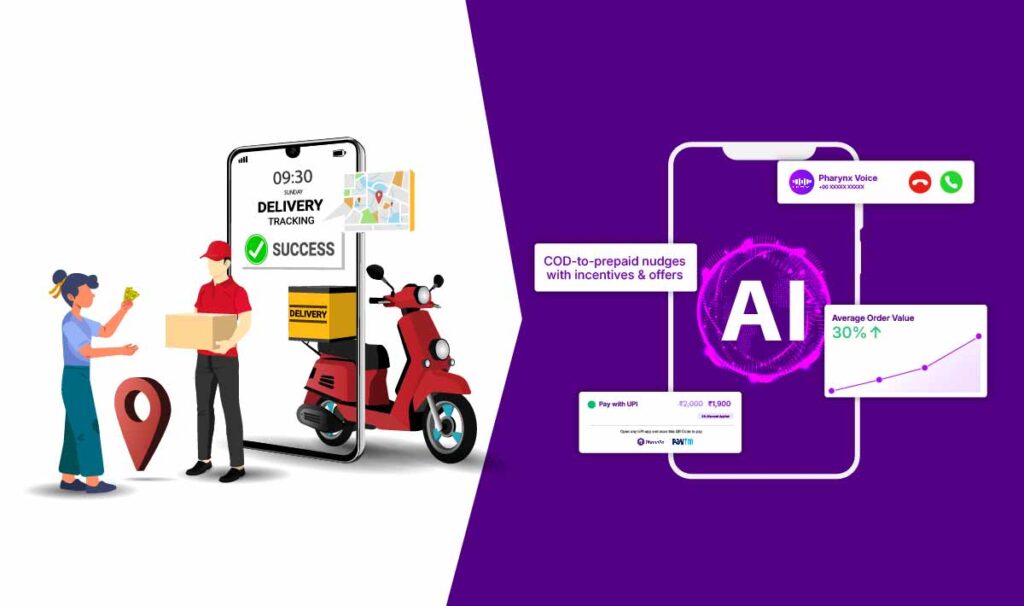
Businesses have growth levers and for D2C, it is COD or cash on delivery. Especially in markets like India, where D2C market is valued at $108.76 billion for the current year, COD plays a critical role (for brands) to gain trust of clients.
Psychologically, COD also plays a role in unlocking first-time purchase for customers.
Brands need to gain credibility, which COD tries to achieve in case of a new brand.
Here is how it plays?
- Acts as a trust bridge
When a customer encounters a brand for the first time, there’s an inherent hesitation:
- Will the product match expectations?
- Is this brand reliable?
- What if something goes wrong?
This is where COD steps in as a powerful “trust bridge.” It removes the immediate financial risk for the buyer and replaces it with psychological comfort: “I’ll pay only after I see the product.”
This simple shift significantly lowers the entry barrier for new customers, making them more likely to complete a purchase.
For emerging D2C brands and unfamiliar product categories, this becomes even more critical.
Without strong brand recall, reviews, or social proof, expecting upfront payments can drastically limit conversion rates. COD, in such cases, is not optional but essential for customer acquisition.
Biggest reason D2C brands continue to rely on COD is its ability to dramatically reduce friction at the checkout stage.
- COD or cash on delivery also fuels impulse buying behavior.
When customers don’t have to commit financially upfront, they are more likely to act on desire rather than deliberation.
A product that catches their attention whether through an ad, influencer recommendation, or limited-time offer can be purchased instantly without overthinking.
COD essentially compresses the decision-making cycle from minutes (or even hours) to seconds.
This is especially powerful in mobile-first markets, where users expect speed and convenience. Any delay be it a slow payment gateway or an OTP error can break the momentum and lead to drop-offs.
The result is clear: higher conversion rates at checkout. By removing friction and enabling quick decisions, COD helps brands capture demand in the moment before doubt, distraction, or technical issues can intervene.
- Must-have for cash preferred customers
While digital payments are growing rapidly, not all customers are equally comfortable with them.
A significant portion of shoppers still prefer cash either due to habit, limited exposure to digital tools, or concerns around security and fraud. For these users, COD is more of a necessity than a convenience.
Certain customer segments rely heavily on COD.
This includes audiences in Tier 2 and Tier 3 cities, where digital payment adoption, although improving, is still inconsistent.
It also includes older demographics who may not be as familiar or confident with online transactions.
Additionally, first-time online shoppers or low-trust users often hesitate to share card or UPI details, especially with new or lesser-known brands.
For these groups, COD removes the complexity and perceived risk associated with digital payments.
It aligns with their existing behavior paying only when the product is physically in hand making the transition to online shopping smoother and more acceptable.
This is what makes COD a powerful tool for inclusivity.
By offering COD, D2C brands don’t just cater to digitally savvy users but they also open their doors to a much wider audience base that would otherwise be excluded from the purchase journey.
The impact is strategic: COD helps expand the total addressable market (TAM). Brands are no longer limited to customers who are comfortable paying online; they can now reach deeper into diverse geographies, income groups, and digital maturity levels.
The hidden risks of COD: Understanding RTO and its impact

While Cash on Delivery (COD) plays a crucial role in driving conversions, it also introduces one of the most significant operational risks in D2C, which is RTO or Return to Origin.
RTO refers to orders that are shipped to the customer but are not accepted at the time of delivery and are subsequently returned to the seller.
Unlike prepaid orders, where upfront payment commitment is made, COD orders carry a much higher likelihood of failure at the final step of the journey.
This is primarily driven by customer behavior.
In many cases, customers place COD orders with low purchase intent. The absence of upfront payment lowers the barrier to ordering, but it also reduces commitment.
As a result, customers may refuse delivery due to a change of mind, finding a better alternative, or simply losing interest by the time the order arrives.
Another major contributor is fake or non-serious orders.
Since COD does not require payment authentication, it becomes easier for inaccurate or even intentionally misleading orders to enter the system. Additionally, incomplete or incorrect address and contact details further increase delivery failures.
The cumulative impact of these factors is substantial.
A significant percentage of COD orders never get delivered. Instead, they move through a costly reverse logistics cycle being shipped to the customer and then returned to the warehouse.
This results in double logistics costs, including forward and reverse shipping, along with packaging losses and inventory blockage.
Over time, high RTO rates erode margins, distort demand forecasting, and strain operational efficiency.
For D2C brands, this means that while COD may increase order volume, it also introduces hidden inefficiencies that directly impact profitability.
- Revenue loss: The illusion Vs reality
One major drawback of COD-heavy business is misleading growth visibility. At the surface level, D2C dashboards only track orders that are placed, which further becomes the metrics for:
- Measuring campaign performance
- Evaluating growth
- Making scaling decisions
However, this dashboard carries a fundamental flaw when measured order placed do not equal revenue because revenue is only realized when an order is successfully delivered and accepted.
How the gap begins?
In a COD-heavy system, a significant portion of orders never translate into actual sales.
This typically includes:
- Cancelled orders (customer cancels before dispatch or during transit)
- Undelivered shipments (customer refuses at delivery or is unreachable)
For example:
- 10,000 orders placed
- 2,000 cancelled
- 1,500 returned (RTO)
- Only 6,500 successfully delivered
Yet, most dashboards for the given day will still highlight:
10,000 orders. The orders are cancelled over next 2 weeks, thus not giving the actual picture of the ROAS.
The problem that comes with “Inflated Dashboards”
For marketing teams, the dashboards show:
- High conversion rates
- Strong order volumes, and
- Improved top-line numbers
However, at the back what’s being created is inflated growth narrative.
Leadership teams assume, campaigns are working, demand is strong, growth is accelerating.
However, the reality is totally different. A large chunk of this “growth” never converts into revenue.
The real business impact
This disconnects leads to critical consequences:
- Overestimated performance: Brands believe they are scaling efficiently
- Misguided decision-making: Budgets are increased based on flawed metrics
- Inventory misalignment: Forecasting is based on demand that doesn’t fully materialize
Most importantly, earned revenue is significantly lower than reported revenue.
This gap directly impacts profitability, cash flow, and long-term sustainability.
In essence, COD doesn’t just create operational leakage but many times data distortion also.
And when growth decisions are made on distorted data, inefficiency compounds at scale.

Operational & financial headache: the hidden cost of reconciliation
Beyond cancellations, COD introduces a less visible but equally critical challenge in the form of reconciliation complexity.
Unlike prepaid orders, where payment and order data are seamlessly aligned, COD creates a fragmented system where cash, logistics, and order data move independently.
- Cash handling complexity: With COD, revenue realization (read collection) is not immediate. It depends on multiple external variables:
- Delayed settlements: Payments are collected by courier partners and remitted after delivery, often with a lag of several days.
- Courier discrepancies: Mismatches can occur between orders delivered and cash reported leading to disputes that take time to resolve.
- Lost or damaged return packages: In RTO cases, products may be delayed, misplaced, or damaged in transit, adding another layer of financial uncertainty.
This creates a system where revenue is not just delayed but remains uncertain until reconciled.
- Manual, time-intensive processes
Most D2C brands still rely heavily on manual workflows to manage COD reconciliation:
- Matching orders vs payments received
- Tracking returns, refunds, and reattempted deliveries
- Validating courier reports against internal systems
These processes are not only time-consuming but also prone to human error, especially at scale.
- Cross-team impact
COD reconciliation spans across the organization from team to team:
- Finance teams handle settlements, discrepancies, and reporting
- Operations teams track shipments, returns, and inventory movement
- Customer support teams manage escalations related to failed deliveries
The result is; increased coordination overhead, slower decision-making, and higher operational costs.
As a whole. COD not only impacts the margins through RTO but it creates a continuous operational burden that compounds as order volumes grow, making scalability significantly more complex.
Additional risks
COD introduces a set of secondary risks that quietly compound over time. This directly impacts operations and the entire growth engine of a D2C brand.
- Fake and bot orders
COD systems are inherently vulnerable to low-friction misuse. Since there is no payment authentication at checkout, it becomes easier for:
- Fake users
- Bot-generated orders
- Non-serious buyers
to enter the funnel.
These orders move through the same pipeline as genuine ones, but they block inventory, consume logistics bandwidth, and inflate demand signals.
- Address and contact inaccuracy
Another common issue with COD orders is poor data quality.
Customers may:
- Enter incomplete or incorrect addresses
- Provide unreachable or invalid phone numbers
This leads to:
- Failed delivery attempts
- Increased RTO rates
- Higher operational costs
More importantly, it reduces the efficiency of last-mile logistics, where precision is critical.
- Inventory blocking
Every COD order reserves inventory. When a significant portion of these orders fail, it creates the impact in these many ways:
- Stock remains blocked for extended periods
- High-demand products become unavailable for serious buyers
- Inventory planning becomes distorted
This directly impacts revenue potential and supply chain efficiency.
- Logistic inefficiencies
COD amplifies inefficiencies across the logistics network:
- Increased delivery attempts
- Higher reverse logistics volumes
- Inefficient route planning due to failed deliveries
Over time, this leads to:
- Higher cost per delivery, and
- Reduced operational efficiency
- Poor customer experience
Failed deliveries don’t just affect operations, but they impact the entire perception.
Customers who:
- Miss deliveries
- Face repeated delivery attempts
- Experience delays due to RTO cycles
are more likely to associate the brand with unreliability, even when the issue originated from order intent, not execution.
- Skewed marketing metrics
Perhaps the most strategic risk lies in distorted data signals. When fake, low-intent, or failing orders enter the system:
- Conversion rates appear higher
- Campaign performance seems stronger
- Audience targeting gets misaligned
As a result:
Ad spend is optimized toward the wrong segments. Scaling decisions are based on flawed insights. Individually, these risks may seem manageable.
But together, they create a compounding effect where inefficiencies at each stage of the funnel reinforce one another.
That is why COD pose more risk as a system-wide intelligence problem than just being a payment or logistic issue.
Why converting COD to prepaid is critical?
While COD is essential for driving top-of-funnel conversions, increasing the share of prepaid orders is critical for building a sustainable and profitable D2C business.
Of course, brands require to offer COD when they are entering the markets, but they must nudge customers to convert to prepaid for a better overall strategy.
This shift strategically converts high-intent customers to prepaid at the right moment.
- Lower RTO, higher delivery success
The most immediate benefit of prepaid orders is a significant reduction in RTO. When customers pay upfront, their level of commitment increases:
- They are more certain about the purchase
- They are more likely to accept delivery
- They are less likely to cancel impulsively
This creates a direct and measurable correlation where prepaid share is higher and therefore the delivery success remains higher as well.
For D2C brands, this translates into:
- Fewer failed deliveries
- Lower reverse logistics costs
- Improved fulfilment efficiency
- Faster cash flow cycles
COD inherently delays revenue realization. The cycle typically involves:
- Order placement
- Shipment
- Delivery
- Cash collection
- Settlement by courier
This process can take 7–14 days or longer, tying up working capital. But prepaid changes this completely.
With upfront payment:
- Revenue is captured instantly
- There is no dependency on delivery for cash realization
This enables:
- Faster reinvestment into marketing and inventory
- Better cash flow management
- Improved business predictability
- Improved profitability and operational efficiency
Prepaid orders simplify operations across the board.
They lead to:
- Lower logistics losses (fewer RTOs and reattempts)
- Reduced manual intervention (less reconciliation and tracking)
- Cleaner operational workflows
Additionally, with more predictable order fulfillment:
- Inventory planning becomes more accurate
- Supply chain decisions become more efficient
- Strategic advantage: better quality revenue
Beyond operational gains, prepaid orders improve revenue quality. Unlike COD-driven volume, prepaid reflects:
- Higher intent customers
- More reliable demand signals
- Stronger unit economics
This allows brands to:
- Optimize marketing toward high-value segments
- Scale sustainably without hidden leakage
- Build a more predictable growth engine
In essence, converting COD to prepaid ensures a strategic shift toward efficiency, predictability, and profitability.
The challenge, however, lies in how to do this without hurting conversions.
Traditional methods to solve COD Issues and why they fall short
To manage COD-related challenges, most D2C brands rely on familiar communication channels like SMS, email, and WhatsApp.
These methods are widely adopted, easy to implement, and relatively cost-effective.
At a surface level, they appear to address key use cases, including:
- Order confirmation
- Payment nudges
- Delivery communication
However, when evaluated against the complexity of COD behavior, these channels reveal a fundamental limitation.
It has been analyzed that these channels are primarily built for communication and not for conversion. Here is a brief on some of the limitations these options have:
- SMS: high reach, low impact
SMS is typically the first layer of communication used for:
- Order confirmations
- Payment links for prepaid conversion
While SMS ensures high delivery rates, its effectiveness is limited. Customers today are inundated with messages, which includes promotions, OTPs and service alerts creating message fatigue. It doesn’t stop there as:
- Important messages are often ignored
- Links go unopened
- Actions are delayed or never taken
More importantly, SMS is non-interactive and therefore it doesn’t generate any outcome that could help brands to:
- Understand customer hesitation
- Respond to queries
- Influence decision-making
It asks for action but offers no support in taking it.
- Email: informative but inefficient
Emails are used for payment reminders and order updates. But in the D2C context, email suffers from low immediacy and engagement.
Challenges include:
- Low open rates, especially for transactional prompts
- Messages landing in spam or promotions tabs
- Delayed visibility compared to real-time channels
For time-sensitive actions like confirming an order or completing a payment, email is simply not reliable.
- WhatsApp: Better channel, same limitation
WhatsApp has emerged as a stronger channel due to:
- Higher open rates
- Familiar interface
- Rich media capabilities
And brands have already explored it for:
- Payment reminders
- Notifications
- Basic interactions
However, most implementations remain template-driven and one-way. The messages of course aware and educate users but they have limitation that further leads to:
- Limited interaction depth
- No real-time objection handling
- Static flows that cannot adapt to user responses
Even when replies are enabled, they are often rule-based and lack the ability to handle nuanced conversations.
Comparison chart
Channel
| Strength
| Limitation
|
SMS | Research | No interaction |
Info | Low urgency | |
Engagement | Static |
The core gap
Across all three channels, there is capability issues meaning these channels do broadcast information, trigger reminders and push users toward an action but in reality they fail to understand customer intent and address hesitation, which becomes the core problem with COD.
This is why, despite multiple touchpoints and reminders, brands continue to see:
- High RTO rates
- Low prepaid conversion
- Limited insight into customer behavior
What’s missing here is a system that can engage, interpret, and influence in real time.
And that is where AI-led conversational approaches begin to outperform traditional methods.
How AI is solving the COD problem
With AI, specifically voice-led conversational systems, the communication is two way and happens in real-time.
Instead of sending a text message like: “Click here to confirm your order”
Voice AI initiates an interaction: Just confirming, are you available to receive this order today?
This simple shift transforms the experience:
- From passive notification to active engagement
- From assumption to validation
- From static flow to dynamic conversation
- Improved order confirmation
Order confirmation becomes more than a checkbox because it becomes easier to assess customers on various points as AI systems help to analyse:
- Buyer intent: Is the customer genuinely interested?
- Address accuracy: Are delivery details correct and complete?
- Delivery readiness: Will the customer be available to receive the order?
Based on this, the system filters out low-intent or high-risk orders ensuring only high-quality, high-probability orders move forward to fulfilment.
AI enables this through real-time objection handling.
It can:
- Address trust concerns (“Is this product genuine?”)
- Respond to price sensitivity (offer contextual discounts or benefits)
- Clarify delivery timelines
Unlike static messages, AI adapts the tone and gets actionable content and creates a human-like interaction that feels natural, not pushy.
This further results in higher likelihood of prepaid conversion.
- Turning cancellations into insights
In traditional systems, cancellations are dead ends. With AI, they become data sources. When a customer chooses not to proceed, the system asks:
- Could you share what made you reconsider?
It captures structured insights about price concerns, product-related doubts and delivery expectations. This data feeds directly into marketing strategy (for better targeting and messaging), product decisions (pricing, positioning, and feature and customer experience improvements.
Continuous learning loop
Such interactions improve the system every time feedback becomes a part of the loop that helps to make messaging sharper, targeting precise and conversion strategy more effective. Over a period, this creates a compounding advantage.
Instead of isolated touchpoints, brands gain:
- Continuous visibility into customer intent
- Real-time decision-making capability
- Adaptive, personalized interactions at scale
In essence, AI redefines how COD orders are being managed.
This turns a reactive, loss-prone system to a proactive, insight-driven growth engine.
Conclusion: Don’t block a channel for its inefficiencies rather make it work for you with AI
Cash on Delivery has always been a double-edged sword for D2C brands.
On one side, it unlocks access bringing in first-time buyers, enabling conversions in low-trust environments, and expanding reach across diverse customer segments.
On the other, it introduces uncertainty, cancellations, RTO, operational inefficiencies, and distorted business metrics.
This is why many brands are tempted to eliminate COD altogether.
But that approach misses the larger reality.
Consumer behavior, trust gaps, and payment preferences make COD an unavoidable part of the D2C ecosystem, especially in high-growth markets. Removing it may solve downstream inefficiencies, but it comes at the cost of reduced conversions and limited scale.
The real risk, therefore, is not just COD but the fact that it is not managed the right way.
When COD operates without intelligence, without visibility into intent, without mechanisms to filter risk, and without the ability to influence customer decisions, it becomes a source of compounding inefficiency.
But when managed intelligently, the same channel can be transformed and can truly be made the growth lever.
Therefore, the winning strategy is not just eliminating the channel but optimizing it the right way.
The most successful D2C brands are not choosing between COD and prepaid. They are redefining how COD works within their systems.
This means:
- Validating order intent before fulfillment
- Converting high-potential customers to prepaid at the right moment
- Filtering out low-quality or high-risk orders early
- Continuously learning from every interaction
Instead of treating COD as a static payment option, they treat it as a dynamic, optimizable layer in the customer journey.
Final thoughts: from liability to growth lever
The introduction of AI particularly conversational, voice-led systems marks a turning point.
For the first time, brands can:
- Engage customers in real time
- Understand the “why” behind their decisions
- Influence outcomes before losses occur
This fundamentally changes the role of COD.
What was once seen as a necessary compromise can now become a strategic advantage. In the end, the brands that will lead the next phase of D2C growth are the ones that solve it intelligently.
And with AI, COD becomes a lever to optimize, scale, and grow profitably.